Quick Take
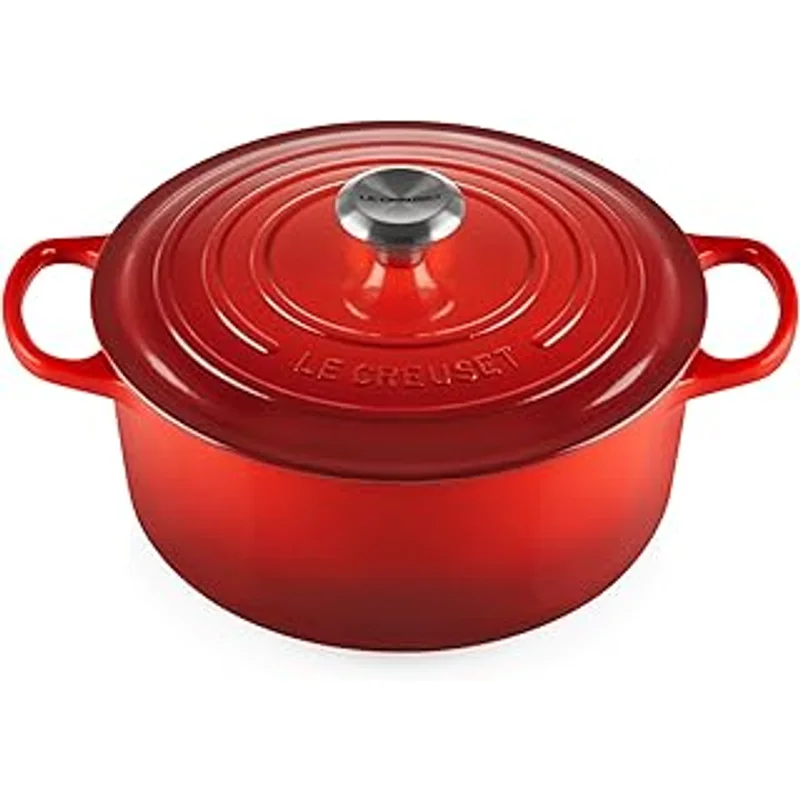
Score: 8.5/10 | Le Creuset Signature is the original enameled cast iron Dutch oven and remains the quality benchmark. Nearly 100 years of French craftsmanship produces cookware that genuinely lasts generations. The premium price is justified by superior enamel durability and a lifetime warranty that Le Creuset actually honors.
What We Evaluated
This review uses the R3 Cookware Methodology v1.0.0, which evaluates cookware across six pillars: Safety (35%), Efficacy (30%), Value (15%), Usability (10%), Sustainability (5%), and Suitability (5%).
Safety Analysis (35% weight)
Le Creuset enamel is porcelain-based, created from glass and mineral particles fused to cast iron at extremely high temperatures. This creates a surface that is:
- 100% PFAS-free - enamel contains no forever chemicals
- Lead and cadmium free in all exterior colors (tested and certified)
- Non-reactive with acidic foods like tomatoes, wine, and citrus
- Chip-resistant with Le Creuset's proprietary formula
- Safe at high temperatures - no coating degradation concerns
The enamel coating also protects the cast iron from rust, eliminating the maintenance concerns of traditional cast iron while maintaining the safety benefits.
One important note: enamel can chip if dropped or banged against hard surfaces. However, chipped Le Creuset enamel does not create a safety concern - the exposed cast iron is food-safe (just season that spot as you would bare cast iron).
Performance & Efficacy (30% weight)
Le Creuset Dutch ovens are designed for slow cooking, braising, and baking bread - tasks where heat retention and even distribution matter most. The 5.5-quart Signature delivers:
- Exceptional heat retention from heavy cast iron construction
- Even heat distribution across the entire cooking surface
- Tight-fitting lid with integrated condensation bumps for self-basting
- Oven-safe to 500F with lid (standard handles)
- Works on all cooktops including induction
For braises, stews, soups, and no-knead bread, Le Creuset performance is outstanding. The thick walls and heavy construction maintain steady temperatures even when you add cold ingredients or open the lid.
The enameled interior does not develop the same natural nonstick properties as seasoned bare cast iron. For searing and browning, you will want to use adequate fat and expect some fond development (which is actually desirable for flavor building).
The Heirloom Factor
This is where Le Creuset truly differentiates itself. These Dutch ovens genuinely last generations:
- 50+ year lifespan is common with normal use
- Family heirloom stories are everywhere in cooking communities
- Resale value remains strong even for used pieces
- Lifetime warranty that Le Creuset honors consistently
- French craftsmanship has been consistent since 1925
I have spoken with families using Le Creuset their grandmothers purchased in the 1960s. These pots are still in regular rotation, often looking nearly new. This is not marketing - it is documented longevity across nearly a century.
Value Assessment (15% weight)
At $400-430 for the 5.5-quart Dutch oven, Le Creuset is expensive. But consider the math:
- $400 / 50 years = $8 per year for heirloom-quality cookware
- Staub comparable runs $360-380 (similar quality tier)
- Lodge enameled runs $80-100 (good but shorter enamel life)
- Tramontina enameled runs $60-80 (budget option with limitations)
The value calculation depends on your timeframe. For a 3-5 year view, Le Creuset looks expensive. For a 30-50 year view, it is remarkably economical.
The lifetime warranty also adds value. Le Creuset has replaced pots with enamel issues even after 20+ years of use. They stand behind their product.
Why Le Creuset Over Staub?
Both are excellent French enameled cast iron. The differences:
- Le Creuset interior is light-colored (easier to monitor browning and fond)
- Staub interior is black matte (better for searing, hides staining)
- Le Creuset handles are larger (easier grip with oven mitts)
- Staub lids have spikes (self-basting condensation feature)
- Le Creuset is slightly lighter due to sand-cast construction
For most home cooks, the choice comes down to: light interior for visibility (Le Creuset) versus dark interior for searing (Staub). Both are excellent.
Manufacturing & Quality Control
Every Le Creuset piece is cast from sand molds that are used once and destroyed - no two pieces are exactly identical. After casting, each pot is:
- Hand-inspected by trained artisans
- Hand-finished on edges and handles
- Individually sprayed with multiple enamel layers
- Fired at 1400F for enamel fusion
- Inspected again before boxing
This labor-intensive process explains the price and the quality. Le Creuset rejects approximately 30% of production that does not meet standards - those seconds are recycled rather than sold.
Usability Considerations
The 5.5-quart Dutch oven weighs approximately 11.5 pounds empty - this is heavy cookware. Filled with stew, you are lifting 20+ pounds. This is not a limitation, it is inherent to how enameled cast iron works (mass equals heat retention).
The large loop handles accommodate oven mitts easily. The lid knob is heat-safe to 500F (older phenolic knobs were limited to 375F - check if you have vintage Le Creuset).
Cleaning is straightforward: warm soapy water and a soft brush handle most situations. For stubborn fond, simmer water in the pot to loosen. Avoid thermal shock (do not put a hot pot under cold water).
The Bottom Line
Le Creuset Signature Dutch Oven is genuinely heirloom cookware - a purchase your grandchildren may inherit. The premium price reflects nearly 100 years of French craftsmanship, superior enamel durability, and a lifetime warranty Le Creuset actually honors. For families who value generational quality and slow-cooking performance, this is the benchmark.