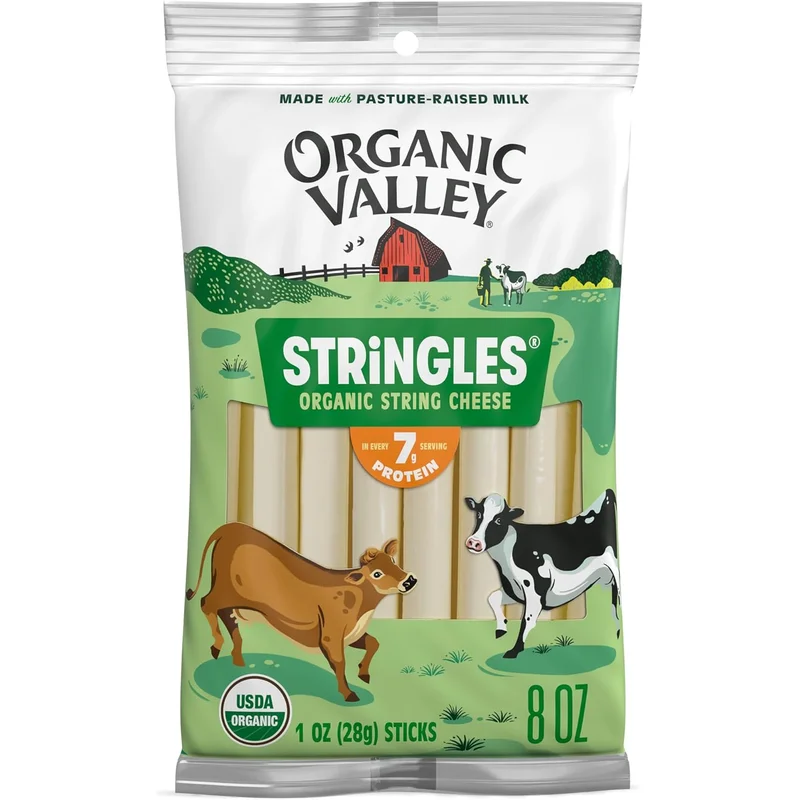
Organic Valley operates differently than most dairy brands, and that difference shows in their string cheese. Here's why these command a premium - and whether it's worth it.
The Cooperative Difference
Organic Valley isn't owned by a corporation - it's a cooperative of over 1,700 family farms. The farmers themselves set the standards and share the profits. This structure incentivizes quality over cost-cutting.
Their organic standards exceed USDA minimums:
- Pasture-raised: Cows spend at least 120 days per year on pasture
- Grass-fed: Grass comprises the majority of their diet
- No feedlots: Even in winter, cows have shelter access, not confinement
- Certified humane: Third-party verified animal welfare standards
Does your kid's string cheese need certified humane cows? Maybe not. But if sourcing ethics matter to your family, Organic Valley leads the industry.
Nutritional Comparison
Per stick:
- 7g protein - same as Horizon and conventional options
- 6g fat - whole milk sourcing
- 15% daily calcium - standard for mozzarella
- 160mg sodium - slightly lower than some competitors
- 0g sugar - as expected for cheese
The ingredients: Organic Part-Skim Milk, Cheese Culture, Salt, Microbial Enzyme. Four ingredients, nothing unexpected.
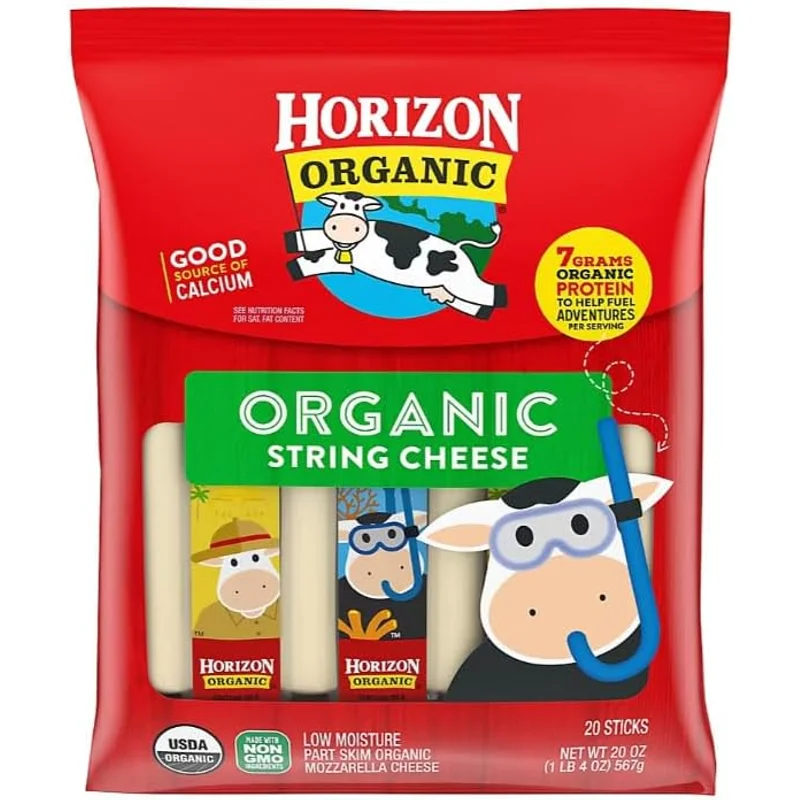
Nutritionally, these are nearly identical to Horizon. The differentiation is sourcing philosophy, not macronutrients.
Grass-Fed Benefits
Grass-fed dairy has a measurably different nutritional profile according to research published in the British Journal of Nutrition:
- Higher omega-3 fatty acids
- More conjugated linoleic acid (CLA)
- Better omega-6 to omega-3 ratio
- Higher vitamin E and beta-carotene
Are these differences significant in a 1oz cheese stick? Honestly, probably not enough to notice. But across hundreds of servings per year, the cumulative effect adds up.
Real-World Assessment
My kids don't distinguish between Organic Valley and Horizon taste-wise. The texture, pull-apart quality, and mild mozzarella flavor are effectively identical. If I gave them both blindfolded, they couldn't tell the difference.
What differs is shelf life and availability:
- Shelf life: Similar to Horizon - shorter than conventional due to no artificial preservatives
- Availability: More limited than Horizon. Whole Foods, natural grocers, some Target locations. Not at every grocery store.
The limited availability is my main practical complaint. When I run out, I can't always find these at my regular store.
The Price Premium
At $8.29 for a 12-pack (~$0.69/stick), Organic Valley costs about 10% more than Horizon and 38% more than conventional Sargento.
Breaking down what you're paying for:
- Farmer cooperative model (fair farmer compensation)
- Grass-fed sourcing (beyond standard organic)
- Certified humane treatment (third-party verified)
- B-Corp certification (social/environmental accountability)
If these values align with yours, the premium makes sense. If you're primarily concerned with organic certification and clean ingredients, Horizon delivers that at lower cost.
Who Should Buy This
Families who prioritize:
- Grass-fed dairy specifically
- Certified humane animal treatment
- Supporting farmer cooperatives over corporations
- "Beyond organic" sourcing standards
These are values-driven purchases, not nutrition-driven. The string cheese itself is excellent but nutritionally equivalent to Horizon.
Who Might Choose Horizon Instead
- Families satisfied with USDA Organic standards
- Budget-conscious buyers
- Those who need wider availability
- Anyone not specifically seeking grass-fed certification
The Verdict
Organic Valley Stringles represent the premium tier of kids' string cheese - not because the product is fundamentally different, but because the sourcing standards are industry-leading. For families where grass-fed, certified humane, and farmer-cooperative values matter, these justify the premium. For everyone else, Horizon delivers comparable quality at lower cost with better availability.